Table of Contents
Related Blogs
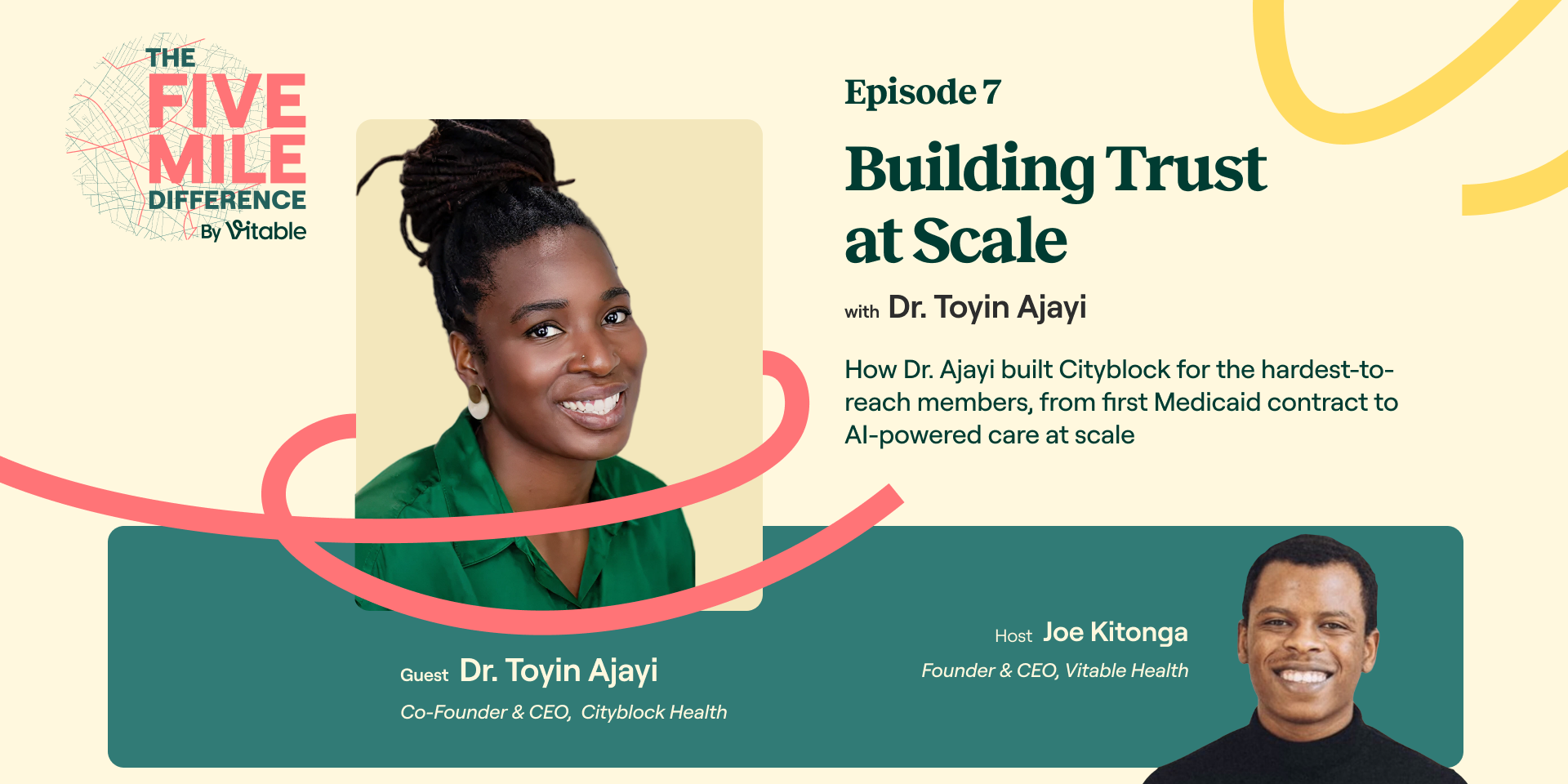




Episode 7: Personalizing Care at Scale
Dr. Toyin Ajayi on AI, Incentives, and Cityblock Health
In this episode of The Five Mile Difference, Joe Kitonga sits down with Dr. Toyin Ajayi, co-founder and CEO of Cityblock Health: the pioneering value-based care company serving Medicaid and dually eligible members across the country. Cityblock has grown from a small team incubated inside Alphabet's Sidewalk Labs to one of the most recognized and respected names in tech-enabled care for low-income and marginalized communities.
The conversation traces Dr. Ajayi's journey from growing up in Nairobi to practicing medicine in Sierra Leone, completing her residency in Boston, and ultimately building one of the most ambitious and mission-driven companies in digital health. Dr. Ajayi opens up about the early thesis that shaped Cityblock, the key insight that trust, not just technology, is the chassis of great care, and what it really takes to serve the populations the healthcare system has historically left behind.
Watch the conversation on YouTube, or listen on your podcast platform of choice: Spotify | YouTube | Apple Podcasts.
Joe and Dr. Ajayi discuss:
- Why for-profit incentives, done right, are the most powerful tool for fixing healthcare for low-income communities
- How Cityblock earned its first major contract by going all-in on Medicaid when no one else wanted to
- Why building trustworthy systems matters as much as hiring trustworthy people
- How Cityblock actually measures trust with a validated tool and member benchmarks
- What moving at tech-speed and venture-scale looks like in a high-stakes clinical environment
- Why AI unlocks personalization at scale for the populations who need it most
- How to bring an entire organization along into an AI-native way of working
Episode Takeaways
From Nairobi to Sierra Leone to Sidewalk Labs: following curiosity toward the people with the most to lose
Dr. Ajayi grew up in Nairobi, studied at Stanford, then did a master's degree and medical school in the UK. She went on to spend about a year and a half in Sierra Leone helping build a nonprofit focused on care for children living in the slums of the capital, at a time when there were only about 50 physicians in the country. She came back to the US for residency in Boston, took on increasingly administrative roles focused on Medicaid and dually eligible patients, and eventually moved to New York to incubate what became Cityblock inside Sidewalk Labs, a wholly owned Alphabet subsidiary focused on technology and urban life. Three themes ran through every step: use technology to improve outcomes for people with the most to lose, build teams and models that are robust and defensible, and align incentives so care is cost effective for the whole system.
Takeaway: Follow your curiosity, get good at something, and look for the place where your experience is uniquely useful.
Why a for-profit? Incentives matter more than governance structure
Having worked in nonprofit, single-payer, and US public-private settings, Dr. Ajayi describes herself as deeply pragmatic. She pointed out that roughly 140 million Americans get coverage through the state or federal government, almost 40% of the population through Medicare and Medicaid. Underneath that sit managed care organizations and health systems, both for-profit and not-for-profit. In her view, the type of entity almost doesn't matter. What matters is whether people are paid to do more things regardless of the outcome for the patient or the taxpayer. A for-profit model, she argues, creates the right pressure to deliver on cost and quality, and it allows the kind of investment needed to redesign care delivery from scratch: questioning the role of the clinic, the provider, and the 10-minute visit, and going to patients proactively instead of waiting for them to show up.
Takeaway: Structure is secondary. Aligned incentives, backed by the ability to invest, are what change care.
Betting on Medicaid when no one else wanted to
Cityblock started as a set of ideas and a small team, with the conviction that Medicaid was an underserved place to build. The model has not had a big wholesale pivot. Cityblock partners with managed care organizations, helps them find their highest-risk and rising-risk members, and takes on accountability for improving their outcomes. Every member Cityblock serves is on Medicaid, and about half are dually eligible for Medicare and Medicaid. Its first contract, which she recalled as probably in the multiple tens of millions of dollars, covered thousands of high-risk patients in her own neighborhood of central Brooklyn. The pitch to health plans was simple: we will find the people you've struggled to reach, give them far more care upfront, and take risk on the outcomes.
The early reception was skeptical. Plans said no one comes to them about Medicaid and that no one wants these members. What changed the conversation was showing up with accountability for the whole problem instead of a narrow point solution.
“People open the door and they answer the phone call.” — Dr. Toyin Ajayi, Co-Founder & CEO, Cityblock Health
Takeaway: The population everyone avoids can be the biggest opportunity, if you come with accountability instead of a point solution.
Trust is the chassis of the care model
The most important early lesson, and one that still drives the company, is that you have to find people and build a relationship of care before outcomes can improve. Those outcomes depend on choices: taking medication daily, calling Cityblock instead of going to the ER when an inhaler runs out, picking up the phone for a conversation about quitting smoking or managing diabetes. People make those choices only if they trust that you have their best interests at heart and will follow through. Dr. Ajayi says the trust gap in these populations is profound, and members are also up against hard constraints like time, access, and health literacy. Earning trust despite all of that is what earned Cityblock the right to scale, and what ultimately produced the savings its customers wanted.
“This is not something you can arbitrage your way out through at arm's length. There is no administrative lever you can pull here.” — Dr. Toyin Ajayi, Co-Founder & CEO, Cityblock Health
Takeaway: In populations with good reasons to distrust the system, there is no shortcut. You have to get close, and you have to follow through.
Trustworthy people aren't enough. You need trustworthy systems
Cityblock's research with members found that trust isn't only about whether an individual seems caring. It's also about whether the system delivers: if someone says they'll follow up, do they? Does it happen on time? Dr. Ajayi called that a technology and operations question as much as a people question. It also explains a paradox. Trust in the healthcare system overall is low, and falling, especially among lower-income people, people with complex needs, and communities of color, yet people still trust their own pharmacist or physician. Good, well-meaning people operating inside broken infrastructure, financial structures, and incentives produce something that feels untrustworthy in aggregate.
Takeaway: Hiring great people is necessary but not sufficient. The systems between the humans have to earn trust too.
Operationalizing trust: you optimize what you measure
How do you turn something as intangible as trust into a business input? Cityblock built and validated a tool that asks members whether they trust the company, the system, and the person they're talking to. It benchmarked results against a sample of the general population and embedded the metric into everything the company does. Dr. Ajayi says they have seen a correlation between higher trust and better outcomes at the individual level, so when they change the model, they can test the effect on trust across the population they serve.
“How many founders do you know can tell you they have a validated tool for measuring trust amongst their customers?” — Dr. Toyin Ajayi, Co-Founder & CEO, Cityblock Health
Takeaway: If you believe trust drives outcomes, measure it, benchmark it, and let it shape product decisions.
Moving fast in healthcare without breaking things
Joe asked about the old startup mantra of moving fast and breaking things. Dr. Ajayi pushed back on the idea that healthcare can't move quickly. The stakes are high, so you need clear guardrails and solid processes, and you test before you scale. She acknowledged that regulatory and operational overhead is non-trivial, but argued that healthcare's very large market lets you amortize those fixed costs and build a high-quality, compliant organization at scale.
Takeaway: Speed and safety aren't opposites. Guardrails and testing before scaling are what make speed possible.
AI as personalization at scale, and why incentives still decide the outcome
For Dr. Ajayi, the real unlock of AI is that it lets you personalize care at scale. Healthcare has historically been one-size-fits-all: the same 10-minute visit whether you need a little or ten times as much. With technology underneath, Cityblock can tailor the experience to each person while taking administrative waste out of the system, so clinicians and frontline staff can operate at the top of their licenses. She added a caveat that she keeps returning to: what you get from AI depends on the incentives. Health systems paid per visit will use it to bill and code more effectively. Joe summed it up as AI-native middlemen with better margins and no change in price for the end customer. Organizations paid to improve access, quality, and cost have every reason to use it in the ways that matter most.
Takeaway: AI amplifies whatever incentives it's pointed at. Align the incentives first.
Becoming AI-native when you didn't start that way
Asked how a company that began pre-AI brings everyone along, Dr. Ajayi named three things. First, build with curiosity and enthusiasm, and model it. She shares her own experiments with Claude with her team on Mondays, including an app she built herself over a weekend. Second, set clear goals and communicate them. This isn't optional. It's tied to how success is measured and to the systems and structures the company puts in place. Third, win hearts and minds by starting with the frontline. Cityblock's first use cases targeted the administrative work that clinicians least enjoy, and team members were the first to feel the benefit. Tasks that took 45 minutes dropped to 20 or even two. When a frontline team member asked the product team for a change, it shipped to production the following week. Cityblock has also been pleasantly surprised by members' willingness to engage with AI, based on focus groups and prototyping with them.
Takeaway: Lead with curiosity, make the goal explicit, and start by making your frontline team's work better.
Resilience: a short memory for setbacks
Asked about the most painful moments in her journey, Dr. Ajayi said she's hit the bingo card: customers that didn't work out, co-founder challenges, employees who weren't the right fit, and wrong business decisions. Her approach is to keep a short memory for setbacks, and for wins too. Setting audacious goals while holding relatively low expectations makes it easier to take a miss in stride, treat it as a learning, and keep going.
Takeaway: Aim high, expect less, and treat setbacks as tuition.
What's next, and what she'd do with a magic wand
Joe closed by asking whether she believes in a single-payer system. Dr. Ajayi said she wouldn't move away from the US public-private partnership, because the market has an important role in driving innovation and investment. What she would remove with a magic wand are the “layers of complicated, obfuscated, non-value generating arbitrage” that sit between payers and patients. In her part of the ecosystem, the payer is already effectively the taxpayer, so the work is to fix what happens underneath when people try to access care. Looking ahead, Cityblock's stated goal is to be the leader in demonstrating how AI can improve access, quality, and outcomes for government programs: Medicare, Medicaid, and to some extent ACA populations.
Takeaway: Keep the public-private structure, cut the layers that add cost without adding value, and use technology where incentives are aligned.
Lessons for founders building in healthcare
- Follow your curiosity and get good at something. Look for where your experience is uniquely valuable.
- Start with incentives. Structure matters less than what people are paid to do.
- Go where others won't, with accountability. Take risk on outcomes and the door opens.
- Treat trust as a metric. Measure it, benchmark it, and tie it to outcomes.
- Build trustworthy systems, not just trustworthy teams. Follow-through is an operations problem.
- Move fast with guardrails. Test before you scale.
- Lead AI adoption by example. Model curiosity, set explicit goals, and start with your frontline.
- Keep a short memory. Set audacious goals, expect less, and learn from every setback.
About our guest: Dr. Toyin Ajayi is the co-founder and CEO of Cityblock Health, a technology-driven care company built to transform health outcomes for Medicaid and dually eligible members. She trained as a physician in the UK, worked on the ground in Sierra Leone building care infrastructure for underserved communities, and completed her residency in Boston before co-founding Cityblock out of Sidewalk Labs. Under her leadership, Cityblock has become a defining example of what value-based care for complex, low-income populations can look like when incentives, technology, and human connection are fully aligned.
Get a quote
Get a personalized health benefits quote tailored to your company’s unique needs.
Ready to learn more?
Stay ahead with the latest insights on healthcare, benefits, and compliance—straight to your inbox.

Download 2025 Employer Guide to ICHRA
Vitable’s ICHRA Guide gives employers a clear, step-by-step resource for building smarter, ACA-compliant benefits.
This guide explains how ICHRAs work, who qualifies, and how Vitable simplifies setup, onboarding, reimbursements, and compliance — while giving employees more flexibility, control, and care.
Download Vitable’s 2025 Broker’s Guide to ICHRA
The Broker Guide to ICHRAs is a comprehensive resource that helps brokers understand, sell, and manage Individual Coverage HRAs with confidence.
This guide covers everything from compliance and class design to administration flows, case studies, and how Vitable streamlines quoting, enrollments, and reimbursements for brokers, employers, and employees.