
Table of Contents
Related Blogs





Here are Vitable deadlines that we run our onboarding and open enrollment (OE) against, which decide whether your client's coverage starts on time. These are Vitable-specific dates that sit earlier than the marketplace deadlines you may be used to.
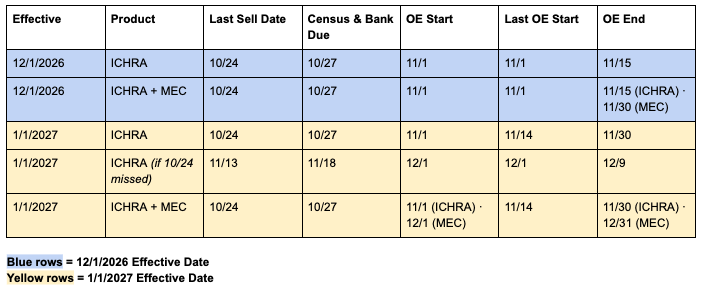
Last Sell Date is the last day we can accept a signed agreement and still guarantee an on-time launch. Census & Bank Due is when the employee census and banking information must be in our hands.
Why these dates sit in October
A CHOICE (Custom Health Option and Individual Care Expense Arrangement), previously known as ICHRA (Individual Coverage Health Reimbursement Arrangement), goes live when every enrolled employee has a bound individual policy — and binding a policy means employer dollars have to be in the right place before January 1.
Our premium funding runs a month ahead: the cycle we run in December is the one that funds January coverage.
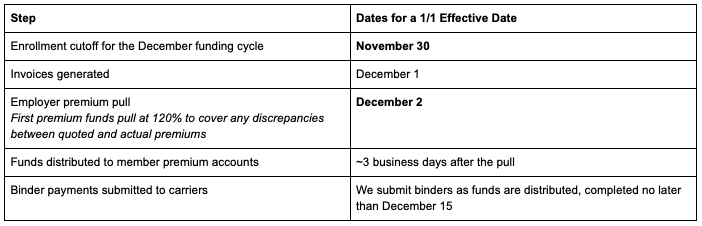
An employee who isn't enrolled by November 30 isn't in Vitable’s December premium funding pull. No funds means no binder, and no binder means no January 1 effective date. Instead, they would land on the next cycle, which is a February 1 effective date.
What a binder payment involves
The binder payment is the first month's premium, which is the payment that activates the policy with the carrier. The sequence is rigid: enroll, fund, bind.
- Applications go in on a rolling basis as employees enroll, well before any money moves.
- Once the premium funds pull from the employer's account, they are distributed into the member’s premium accounts.
- Our team works carrier by carrier (e.g. Ambetter, UnitedHealthcare, Oscar, etc.) to pay each member's binder and confirm autopay is set for the following months. Every binder has to clear before the coverage month begins.
Three things on binders to note to your clients
Binder deadlines vary by carrier. Some run earlier than the plan-selection deadline itself. Our dates are set so the slowest carrier on a census still clears.
Open enrollment cycles fund at 120% of expected premium. Plan pricing can move between quote and bind, so we build in a reserve of an additional 20% for the first funding. Make sure the employer is budgeting against that number when they confirm they can fund.
If you’re on Reimbursement-Only CHOICE: Reimbursement-Only CHOICE members pay their own binder with their own funds and submit reimbursements. This path does not depend on employer funding, which makes the timeline more forgiving.
Two things to notice
MEC runs on its own clock. On a 1/1 combined case, CHOICE open enrollment runs 11/1–11/30 while MEC runs 12/1–12/31. Two enrollment windows will involve two sets of employee communications. Set that expectation with the employer up front so nobody thinks December's outreach is an error.
State-based exchanges run their own calendars. The dates above are built to clear the federal timeline, so they're safe everywhere. If you're working a state-based exchange case and want to know what's actually possible locally, you can check the state's marketplace directly through HealthCare.gov's state listing, or ask us directly. We track carrier and exchange timelines across every state we operate in, and we can scope your state-specific timeline with you to set date expectations for your client.
What to do now
- Pull your 1/1 pipeline now. Anything you're planning to close in November is already on the fallback path.
- Get census requirements in front of prospects early. Clean census data often becomes the bottleneck.
- Confirm the employer can fund a December 2 premium funding pull. A client who can't have premium dollars available that week can't start January 1, regardless of when they sign.
Bring us your cases
If you have a case you want scoped against these deadlines, reach out and we'll tell you whether it can make 1/1 or whether we should build toward 2/1. This way, we can set expectations in September instead of explaining a February effective date in January.
Get a quote
Get a personalized health benefits quote tailored to your company’s unique needs.
Ready to learn more?
Stay ahead with the latest insights on healthcare, benefits, and compliance—straight to your inbox.

Download 2025 Employer Guide to ICHRA
Vitable’s ICHRA Guide gives employers a clear, step-by-step resource for building smarter, ACA-compliant benefits.
This guide explains how ICHRAs work, who qualifies, and how Vitable simplifies setup, onboarding, reimbursements, and compliance — while giving employees more flexibility, control, and care.
Download Vitable’s 2025 Broker’s Guide to ICHRA
The Broker Guide to ICHRAs is a comprehensive resource that helps brokers understand, sell, and manage Individual Coverage HRAs with confidence.
This guide covers everything from compliance and class design to administration flows, case studies, and how Vitable streamlines quoting, enrollments, and reimbursements for brokers, employers, and employees.