Table of Contents
Related Blogs


Episode 8: Never Call Yourself a Startup
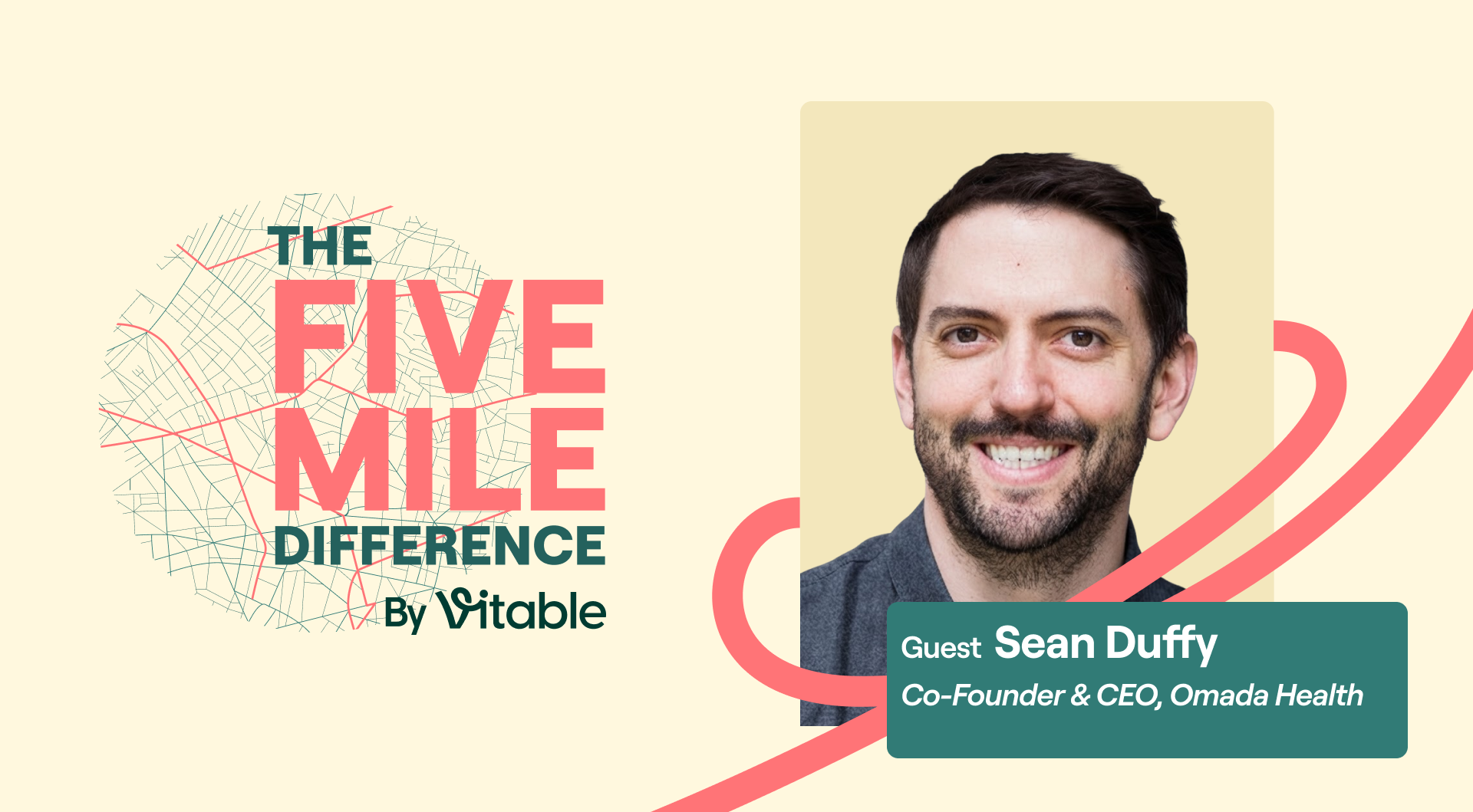
Omada's Sean Duffy on Evidence, Distribution, and Lessons Learned Over 15 Years of Building
In this episode of The Five Mile Difference, Joe Kitonga sits down with Sean Duffy, co-founder and CEO of Omada Health: the digital health company supporting members with diabetes, weight, hypertension, and other chronic conditions. Sean started Omada as a medical student and, fifteen years later, has taken it public.
The conversation covers the early decisions that shaped Omada, how Sean learned enterprise healthcare distribution, the sales and operations lessons that came with scale, and how Omada is thinking about AI and GLP-1s.
Watch the conversation on YouTube, or listen on your podcast platform of choice: Spotify | YouTube | Apple Podcasts.
Joe and Sean discuss:
- Why Omada started with the clinical literature and published evidence early
- Why plans and employers have to be pursued in parallel
- What enterprise healthcare sales reps need that other reps don't
- Why ComOps should be hired earlier than you think
- When to go from one product to a multi-condition platform
- Why aligned revenue models and member-centric goals matter
- What going public felt like, and how Omada uses AI and GLP-1s
Episode Takeaways
Starting with the literature, then publishing your own
Sean was in medical school when he founded Omada. He didn't know the business of healthcare, but he could read a trial. He went beyond the headlines to the methods papers: what exactly did these lifestyle and diabetes self-management programs do, what was the curriculum, and how did they create accountability? The findings were both inspiring and harrowing. Interventions existed that could move the needle clinically, but none had scaled, with an emotional and behavioral side as well as a medical one. Knowing that digital health was the underdog, and imagining he'd have to convince skeptical medical school classmates, Omada began publishing studies early and has kept at it.
Takeaway: In a skeptical market, evidence is the product's first sales pitch.
Distribution is the harder problem
Sean says building the member experience, with hardware, care teams, and software for members and clinicians, was ironically the easier part. Distribution was very complex, and he started without knowing what a self-insured employer was. One creative approach: working with the AMA, using Omada's trials, to get a Category III CPT code approved. That let Omada use fee-for-service claims infrastructure with a value-based model, giving employers a path to implement. His advice to founders entering enterprise healthcare is to approach it with humility. Fifteen years in, he's still learning how the system works.
Takeaway: Figure out how what you're building fits into the system, so that it can actually be distributed.
Winning the first customers when you're "a startup"
Enterprise healthcare is a risk-averse buying market that tends to shy away from startups, so Sean never called Omada one. He recalls a health plan medical director in a WeWork conference room pointing out that Omada's entire workforce was six people, and asking what gave him confidence the company would be around for a five-year contract. Some leaders walk out. Others make a bet for a cause bigger than themselves, and Sean says you never forget them. Omada's first customers were one plan and two employers, all still customers today. They happened in parallel, which Sean calls a big misconception to get right: you don't pick plan or employer, because employers are the plans' customers.
Takeaway: Find the passionate leader willing to make a bet on you, and pursue plans and employers in parallel.
Three chapters of building
Sean thinks of Omada's story in chapters. First: will what you build work at all? Omada's version of an MVP was a "minimum clinically viable product," because the bar for a clinical result is higher. Second: will anyone pay for it? Omada chose enterprise over consumer because past a hundred-dollar price point, many people who need metabolic care are out of reach. Third: can you build a repeatable sales motion and the infrastructure behind it, followed by more products, more scale, and a healthy P&L built to last.
Takeaway: Sequence matters: prove it works, prove someone will pay, then prove you can repeat it.
Hiring for enterprise healthcare sales
Enterprise healthcare sales involves benefits buyers, TPAs, PBMs, a complex consulting landscape, and very long sales cycles, so there's little room for misfires. Sean says Omada gravitated toward a "Navy SEAL" profile: fewer reps, more expensive, more effective. He also cautions that great resumes can hide the difference between reps who are always invited to the finalist meeting and reps who can get in the door as an unknown. When interviewing, probe how candidates got into the room in the first place, not just what they did once they were there.
Takeaway: For new-category sales, hire for creativity in getting in the door, not just execution once inside.
Invest in commercial operations earlier than you think
Scaling is all about commercial operations: territories, commission structures, quotas, stretch targets, and when to expand the sales force. Sean says every layer has to stack together artfully, and it gets messy if it doesn't. The entrepreneur's instinct is that this is their job, but you need an operator within the sales org, and it's a fully hireable skill. His own mistakes included posting new account executive roles without thinking through territory impact, and rolling out a half-baked incentive plan that took a lot of re-communication to fix.
Takeaway: Hire a ComOps leader early. It's normal for the bolts to start coming loose, and it's all fixable.
Align your revenue model so there's no trade-off
Sean's number-one principle for balancing impact and venture-scale growth is to build a revenue model that doesn't create a trade-off. He contrasts Omada with digital health companies that sold a per-employee-per-month fee, where fewer sign-ups means better margins. Omada charges only when someone signs up, keeps charging only if they stay engaged, and offers performance guarantees on clinical outcomes. That combination means Omada can only succeed if customers and members do.
Takeaway: Design the revenue model so growth and impact point the same way.
Set goals around impact, not revenue
Internally, Sean says Omada tries not to set financially oriented goals. The goals are members enrolled, members retained, and clinical outcomes, and the P&L becomes the output. Picking a revenue number and communicating it as the company goal is where healthcare companies can go wrong. He wants people motivated by impact, and says that if they're motivated by the financial number, they shouldn't be at Omada.
Takeaway: Make the goal the things that produce the revenue, not the revenue itself.
Venture, investors, and going multi-product
Sean believes enterprise healthcare is capital intensive and that venture is perhaps the only path. He preferred investors with healthcare experience, because they understand certain unavoidable truths, such as sales cycles that can't be shortened and just how expensive clinical trials can be. On expanding from one product to many, he says it's harder than expected: you have to change your sales force structure, train reps differently, and almost rebrand the company. His advice is to do it selectively, let customers drive it, and wait until the company has earned the right, which he guesses is around the hundred-million-dollar revenue mark.
Takeaway: Expand when customers keep asking for the same thing and your operations can absorb it.
Going public: a Series A all over again
Sean never aspired to go public, but he's come to believe the public markets are the best path to building a large-scale, durable business. He describes the experience as the closest thing to a company wedding, and says the best part was feeling like he was back at Series A: a small fish in a big pond, with investors asking whether the company can get to billions in revenue. He says there's more that's the same than different, as long as you communicate that it's never a destination.
Takeaway: An IPO is a ticket of entry to expanding impact, not a finish line.
GPTs and GLP-1s: the year of the G's
Sean sees three growth levers: what Omada can sell and to whom, awareness and enrollment, and engagement. AI is an amplifier for all of them. Omada avoided reflexively launching a chatbot and instead pushed every product manager to design with an AI mindset around the specific job to be done. One example is snapping a picture of a meal and having it assessed against Omada's nutrient-density approach. He says members don't feel accountability to a large language model, so the goal is care teams doing what people should do and models doing the knowledge-based tasks. On GLP-1s, he argues medication alone is never enough. Momentum from a GLP-1 can create behavioral inertia that makes members open to change, which he calls the grocery cart testimonial.
Takeaway: AI and GLP-1s are most powerful when tied together with care teams, behavior change, and the right operating layer.
Contrarian belief: there is no silver bullet
Sean's contrarian view, learned through experience, is the single instrument fallacy. There are randomized controlled trials on almost every piece of Omada that would show a null result on its own. The answer is always a full-stack approach with all the needed pieces. He also believes digital health has moved from 1.0, selling technology to others, to 2.0, delivering the care itself within new reimbursement frameworks, which opens up a much larger market.
Takeaway: Don't look for the one thing. Build the full stack.
Lessons for founders building in healthcare
- Start with the evidence. Read the methods, then publish your own.
- Approach distribution with humility. Learn how all the stakeholders fit together.
- Pursue plans and employers in parallel. Each is a route to the other.
- Hire for getting in the room. New-category sales is different from sales at a household name.
- Bring in ComOps early. It's a hireable skill and a common bottleneck.
- Align your revenue model. Charge only when members enroll and stay engaged.
- Set goals around impact. Let the P&L be the output.
- Expand selectively. Let customers pull you into the next product.
- Don't look for a silver bullet. Build the full stack.
About our guest: Sean Duffy is the co-founder and CEO of Omada Health, a digital health company that supports members with diabetes, weight management, hypertension, cholesterol, and musculoskeletal conditions through care teams, technology, and clinically validated programs. He founded Omada while in medical school and has led it through fifteen years of growth to the public markets.
Get a quote
Get a personalized health benefits quote tailored to your company’s unique needs.
Ready to learn more?
Stay ahead with the latest insights on healthcare, benefits, and compliance—straight to your inbox.

Download 2025 Employer Guide to ICHRA
Vitable’s ICHRA Guide gives employers a clear, step-by-step resource for building smarter, ACA-compliant benefits.
This guide explains how ICHRAs work, who qualifies, and how Vitable simplifies setup, onboarding, reimbursements, and compliance — while giving employees more flexibility, control, and care.
Download Vitable’s 2025 Broker’s Guide to ICHRA
The Broker Guide to ICHRAs is a comprehensive resource that helps brokers understand, sell, and manage Individual Coverage HRAs with confidence.
This guide covers everything from compliance and class design to administration flows, case studies, and how Vitable streamlines quoting, enrollments, and reimbursements for brokers, employers, and employees.